


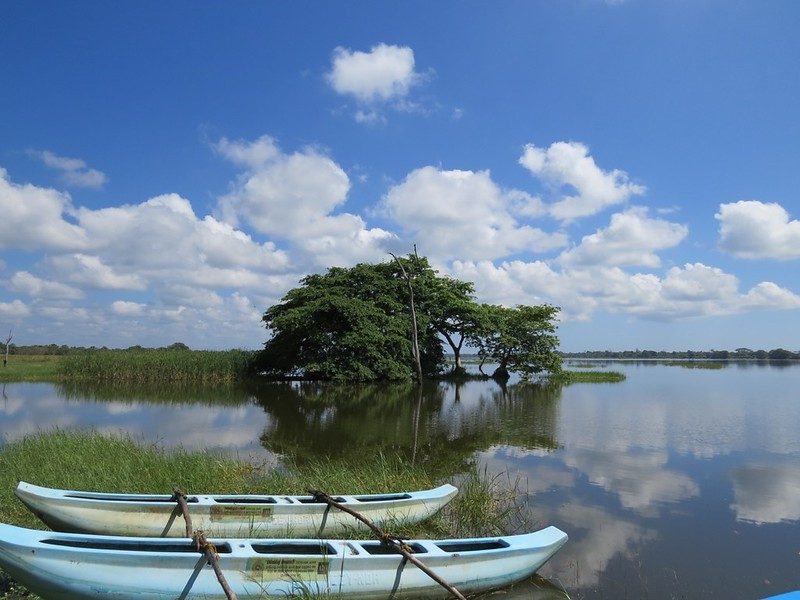
An inland irrigation reservoir under cloud, a stand of trees standing in the shallows
Reservoirs
Where we stock
Divron's prawns are not grown in ponds. Post-larvae go into 120 of Sri Lanka's inland irrigation reservoirs, some of them two thousand years old, and are grown out by the fisher communities who work them. It is a sustainable way to grow the animal for a plain reason: nothing is pumped in, and only prawns that have reached size are taken, so the water is as productive next season as it was this one.
Divron’s reservoir network
- Reservoirs we collect from, roughly
- Collection centre
- Hatchery
Pamunugama / Negombo
Hatchery
On the west coast. Broodstock selection, larval rearing, and the post-larvae that stock every reservoir in the network.
Collection centres
Nine
Post-larvae go out to the reservoirs around each centre, and the harvest comes back the same way, iced at the shore and held cold before it moves on. Five sit inland across the dry-zone tank country, where the reservoirs are; four are on the coast.
- Vavuniya
- Anuradhapura
- Mutur
- Kalpitiya
- Galgamuwa
- Dambulla
- Polonnaruwa
- Batticaloa
- Down South
The reservoirs
Grow-out
Divron does not own them. It stocks 120 inland tanks and reservoirs within reach of the collection centres, some of them holding water since the 3rd century BC, and the fisher communities who already work them do the tending and the harvesting. Which tanks they are stays between Divron and those communities.
Studied, not just claimed
Stocking giant freshwater prawn into Sri Lanka's reservoirs is not a private claim. It is recorded in the National Aquaculture Development Authority's logbook database, and it has been analysed independently: published research covering 2011 to 2017 tracked the programme growing from 48 reservoirs in 2014 to 120 by 2017.
Reservoirs are not chosen on availability alone. Each is selected for water quality and natural productivity, and in partnership with the fisher community that already works it: the people who will stock, tend and harvest it.
Network at a glance
- Reservoirs stocked
- 120
- Collection centres
- Nine
- Region
- Sri Lanka's dry-zone tank country
- Hatchery
- Pamunugama, on the west coast
- Water bodies
- Small tanks to large inland reservoirs
- Selection
- With the fisher community that works each one
This page is the where. What happens once post-larvae go into the water, how a stocking is planned and what turns a juvenile into a 600 g animal, is the grow-out stage.
See the grow-out stageEvery box can be traced back to the water it came out of.
Grade, weight and the batch behind them are recorded at our facility. Ask how the chain works and we’ll walk you through it.